How To Compare Options For A Kitchen Knife Routine That Makes Prep Less Tiring
A practical step-by-step guide to how to compare options for a kitchen knife routine that makes prep less tiring, including preparation, instructions, common issues, tips, and next steps.
How To Compare Options For A Kitchen Knife Routine That Makes Prep Less Tiring
A well-planned kitchen knife routine reduces fatigue by matching each cutting task to the right blade, improving your grip and stance, and maintaining a sharp edge so you use less force. This guide helps you compare knives for chopping vegetables, slicing meat, and mincing herbs, then build a simple routine that preserves energy during long meal prep sessions.
Fast Answer
- Choose a chef's knife for most tasks because its curved blade lets you rock-chop with less wrist effort.
- Use a paring knife for small, precise cuts so you don't overgrip a large blade and tire your hand.
Before You Start
- Clear your cutting board and secure it with a damp towel underneath to stop slipping.
- Select two or three knives you already own or plan to try; do not buy new ones yet.
- Gather a few onions, carrots, potatoes, and a bunch of fresh herbs for testing.
- Wash and dry all produce, then set up a comfortable stool or mat so you stand at a relaxed height.
Step-by-Step Instructions
Assess Your Current Cutting Posture and Grip
Stand facing the cutting board with your feet shoulder-width apart and your elbows relaxed at about 90 degrees. Hold the knife handle with your thumb and index finger pinching the blade's heel—this is called the pinch grip—and wrap your remaining fingers around the handle. Practice a few up-and-down chops, lifting only your forearm, not your shoulder. Many people grip the handle too tightly or extend the index finger along the spine, which increases muscle tension. After two minutes of chopping, check whether your wrist feels strained or your forearm aches. That discomfort tells you that your grip or posture needs correction before you compare knives. The goal is a relaxed but secure hold that lets the blade do the work, so your hand stays loose between cuts.
Test Blade Weight and Balance in Your Hand
Pick up each candidate knife and hold it in your pinch grip, then let it rest on your index finger near the handle's bolster. Notice whether the knife falls toward the handle, tipping forward toward the blade, or feels point-heavy. A balanced knife should feel comfortable, but the right choice depends on the task: for continuous chopping, a slightly heavier blade helps power through dense vegetables, while a lighter blade reduces strain during many minutes of fine slicing. Chop one carrot into coins with each knife, using the same speed and pressure. Feel how much downward force you need and how easy it is to guide the blade. If a knife forces you to tighten your wrist to control it, that extra tension will make prep tiring. Choose the knife that feels like an extension of your arm, not a tool you must wrestle with.
Evaluate Blade Shape for Rocking and Slicing
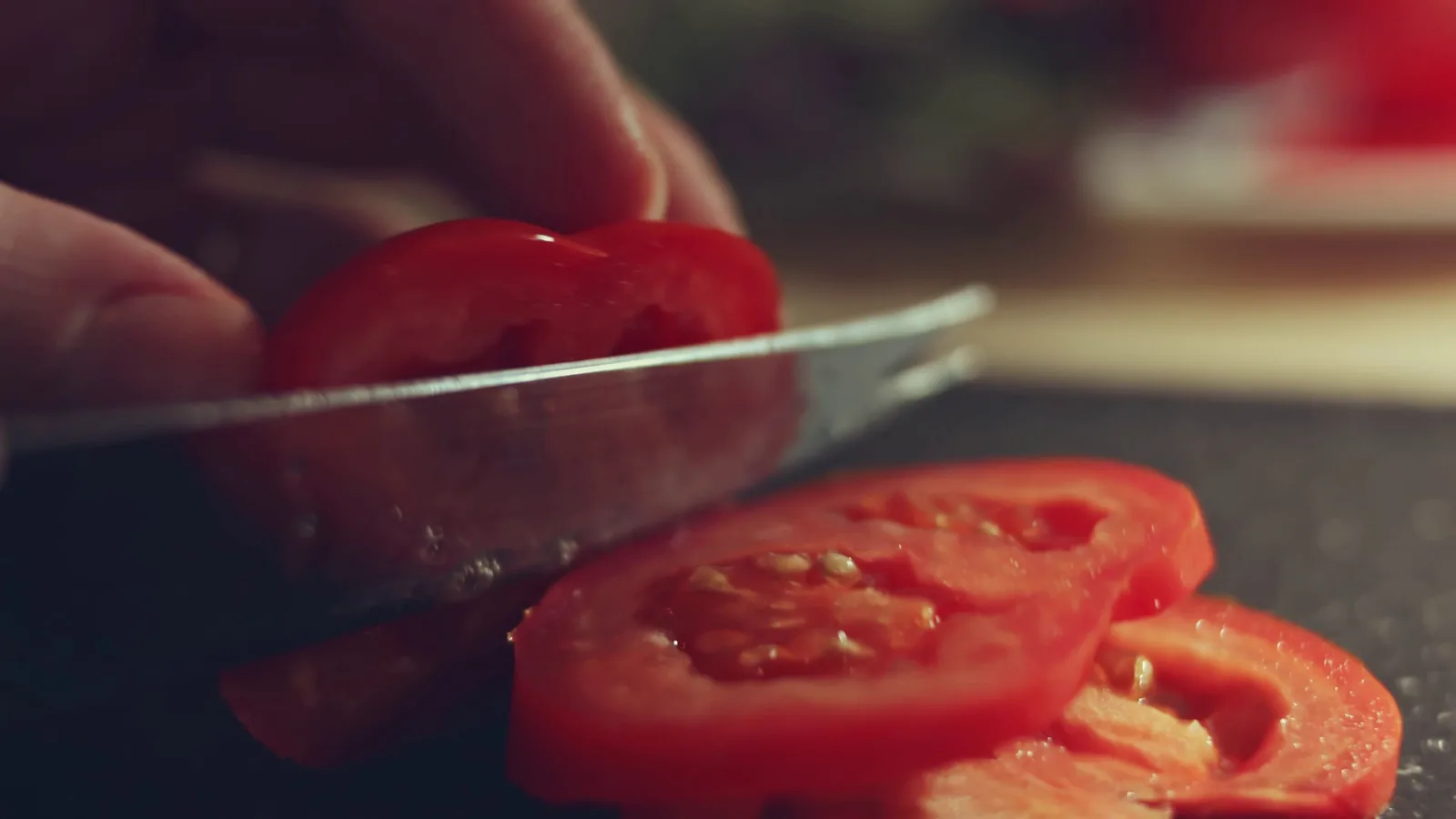
Place an onion on the board and cut it in half, then test each knife with a rocking motion: keep the tip on the board and move the handle up and down in a smooth arc. A chef's knife with a curved belly makes this easy, while a straight-edged knife forces you to lift the entire blade for each cut, which is more tiring. Now slice a tomato with a single, gentle pull-back motion; a sharp, thin blade will part the tomato without crushing it. Finally, mince a few parsley leaves by holding the tip down and rocking rapidly; the blade's curve should let you do this with minimal wrist movement. If any knife forces you to change your natural rocking rhythm or requires excessive lifting, it will increase fatigue over a long prep session. This test reveals which blade shape matches your cutting style.
Test Cutting Efficiency on Dense Vegetables
Cut a sweet potato into thick slices, then into matchsticks, using each knife. Notice how much force you must apply to push the blade through the dense flesh. A sharp, heavy knife will glide through with less downward pressure, while a dull or thin blade requires extra effort. Chop a butternut squash quarter into chunks; this tests the blade's ability to handle hard, irregular shapes without twisting your wrist. If you find yourself leaning your body weight onto the knife or using a sawing motion, that is a sign the edge or blade geometry is inefficient. Efficient cutting is not about brute force—it is about clean, even strokes that use your arm's momentum. For a tiring routine, choose the knife that lets you cut dense vegetables with minimal exertion, because you will likely encounter them often.
Compare Fine Work with a Paring Knife
Perform delicate tasks with each paring knife: peel an apple, devein a shrimp, and remove the eyes from a potato. Hold the knife like a pencil, with your thumb and index finger near the blade's base. Notice how much wrist flexion and finger pressure each knife requires. A short, nimble blade allows precise control, while a longer blade is harder to maneuver in tight spaces. Try mincing a garlic clove with the paring knife, using a small, steady rock. If you feel your hand cramping, the grip may be too thin or too thick for your hand size. The right paring knife is one that you can use for several minutes without your hand getting tired, because fine work often takes the most time. Compare at least two paring knives to see which one lets you work closely without excessive curling of your fingers.
Choose Your Routine and Set Up a Sharpening Habit
Based on your tests, assign each knife a primary role: one all-purpose chef's knife for most vegetables and herbs, one heavier blade for dense squash and hard items, and one paring knife for small, detailed work. Write a simple daily routine: start with a quick rinse and dry, then use the chef's knife for onions and herbs, switch to the heavier blade for squash, and finish with the paring knife for garnishes. After each prep, clean and dry the blades, then hone them with a steel if you have one. To maintain sharpness, sharpen your knives on a whetstone or with a sharpening system every few weeks, depending on use. A sharp edge is the single biggest factor in reducing fatigue because it cuts with less resistance. Test your knife's sharpness by slicing paper; if it tears, it is time to sharpen.
Quick Reference
| Situation | Action | Why it helps |
|---|---|---|
| Chopping a large pile of onions for soup or stir-fry | Use your chef's knife and rock-chop, keeping the tip on the board, and hold the onion with curled fingers. | The curved blade and rocking motion let you cut with a smooth, continuous motion instead of lifting the knife for each slice, which saves arm effort. |
| Peeling or deveining shrimp for a quick weeknight dinner | Switch to a paring knife and hold it like a pencil, guiding with your thumb and forefinger near the blade. | The short blade gives you precise control and reduces the amount of wrist movement needed, so your hand does not fatigue during delicate work. |
| Breaking down a butternut squash for roasting or soup | Use your heaviest chef's knife, and first halve the squash by rocking the blade through the flesh, then slice into chunks. | The added weight and longer blade provide enough momentum to cut through dense flesh with less downward force from your arm. |
Common Issues
- Your knife feels dull even after sharpening, so you press harder to cut.: Check the blade angle; a standard chef's knife is typically sharpened at a 15-20 degree angle. Use a honing steel before each use to realign the edge, and resharpen with a whetstone every few weeks, following the same angle each time.
- Your hand cramps after a few minutes of chopping.: Loosen your grip to a relaxed hold, using your thumb and index finger to pinch the blade and other fingers to merely wrap around the handle. Take a 30-second break to shake out your hand every 5 minutes. Also ensure your knife's handle fits your hand size; a too-thin handle forces a tight grip.
- Your cutting board slips on the counter, making you brace yourself.: Place a damp paper towel or a non-slip mat under the board to hold it steady. If the board is warped or has a glossy finish, it may need a new board; a heavy wood or composite board is best.
Advanced Tips
- Work your way through hard vegetables first, then softer ones, so you intuitively use the right knife when your energy is highest.
- Practice a continuous rocking rhythm by counting 'down-up-down' as you chop; this builds muscle memory that lowers extra arm lifts.
- Use a bench scraper to gather chopped food and move it into a bowl; this reduces repetitive reaching and keeps your board clean.
Final Checklist
- I have tested at least two knives with a pinch grip, and I can chop an onion with minimal wrist strain.
- I have chosen a primary chef's knife that balances well and feels comfortable during a 10-minute chopping session.
- I have set up a sharpening routine with a honing steel and a whetstone, and I know my knife's preferred angle.
- I have arranged my cutting board, towels, and ingredient bowls so that I can prep without bending or stretching.
FAQ
How often should I sharpen my kitchen knife to keep prep easy?
Hone the blade with a steel before each use, as this realigns the edge and keeps it sharp between full sharpenings. A full sharpening with a whetstone is needed every two to four weeks for regular home use, but test the edge by slicing a ripe tomato or a piece of paper. If the blade crushes the tomato or tears the paper, it is time to sharpen again.
What is the best way to hold a chef's knife to avoid hand fatigue?
Use a pinch grip: place your thumb and index finger on the blade's heel, just above the handle, and wrap your remaining fingers loosely around the handle. This grip gives you precise control and allows the knife to pivot naturally, so you do not have to strain your wrist. Keep your grip relaxed, and let the edge do the cutting by guiding the blade with a gentle rocking motion.
How can I make chopping herbs faster without getting tired?
Use a chef's knife with a curved blade and a rocking motion: keep the tip on the board and move the handle up and down in a smooth arc. Gather the herbs into a tight pile and rock continuously, moving the blade in a slight fan pattern. This technique uses arm momentum rather than wrist strength, so you can chop quickly for several minutes without fatigue.